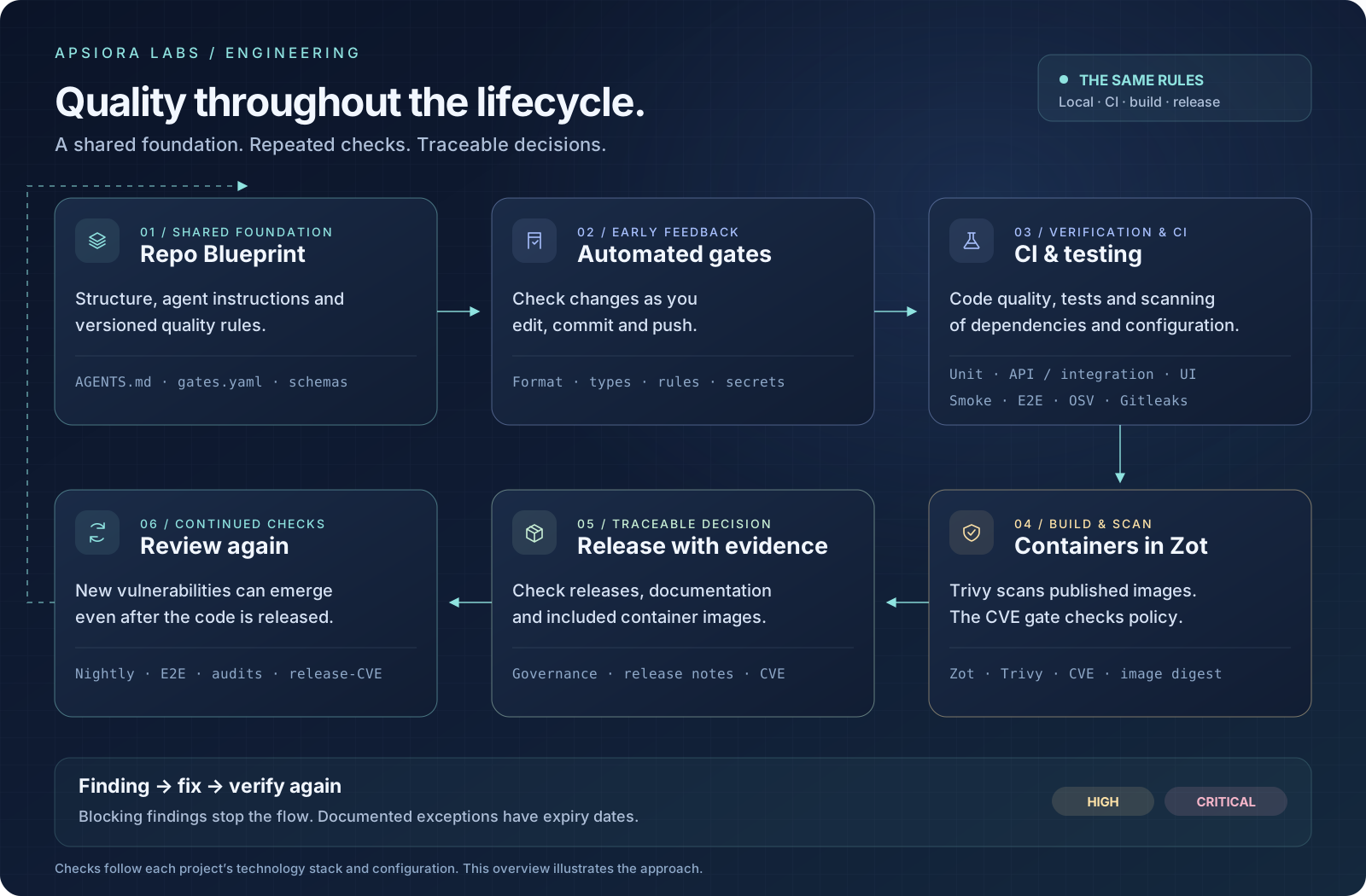
From the first code change to the next release. We use a shared foundation, automated checks and several layers of testing to make quality and security part of development itself.
Repo Blueprint The same rules locally and in CI Checks continue after release
One source of rules. Several checkpoints. Checks are enabled according to each project’s technology stack and configuration. The illustration shows the approach and can be opened at full size.
02 / WHAT WE CHECK
Four complementary layers.
CODE & STRUCTURE
Rules we can verify.
Repo Blueprint brings together repository structure, document metadata and instructions for people and agents. Formatting, types, coding rules and architectural boundaries are checked automatically.
Biome / ESLint
TypeScript / .NET
Dependency Cruiser
JSON Schema
BEHAVIOUR & FUNCTIONALITY
Test the parts. Test the whole.
Unit tests check logic, API and integration tests check how components work together, and UI tests check the interface. Smoke tests check that services start and respond. E2E tests follow the user’s journey through the entire product.
Vitest / xUnit
Testcontainers
Compose smoke
Playwright
DEPENDENCIES & CONFIGURATION
Catch risks around the code.
Dependencies are checked for known vulnerabilities. Secrets in Git history, Dockerfile rules and risky deployment configuration have dedicated checks in CI.
OSV Scanner
npm / pnpm audit
NuGet audit
Gitleaks
Hadolint
Trivy config
CONTAINERS & RELEASE
Check what will actually run.
Built container images are sent to Zot and scanned there with Trivy. The CVE gate reads results for the image digest, the identity of that exact build. Release checks review the images listed in the release evidence.
Zot registry
Trivy
CVE-gate
Image digest
Release notes
03 / THE TEST PIPELINE
From one function to an entire user journey.
Unit tests, API and integration tests, UI tests, smoke tests and E2E tests answer different questions. UI and E2E can use the same browser tools while testing different scopes.
01
Unit
Does the individual function work correctly?
Logic & edge cases
02
Integration
Do the components work together?
API, database & services
03
UI
Do views, forms and interactions work?
Interface & browsers
04
Smoke
Does the built stack start and respond?
Health & key endpoints
05
E2E
Does the flow work from start to finish?
Complete user journeys
Fast feedback: unit and API tests in the project’s local checks and CI.
Real interactions: integration tests during verification and CI, plus Compose smoke tests during verification.
Browser flows: UI/E2E in the project’s verification pipeline and scheduled runs. Blueprint’s nightly stage includes E2E; Ticketeer’s verification also runs UI tests in a Playwright container.
04 / WHEN A CHECK FINDS SOMETHING
A finding should lead to a decision.
A gate produces a verifiable result. A blocking finding stops the check until it is fixed or covered by a documented exception with an expiry date.
HIGHCRITICAL
Default threshold for the container CVE gate.
Clear thresholds
By default, the container CVE gate blocks HIGH and CRITICAL findings without a valid accepted exception. Each project’s policy determines which findings block progress.
Exceptions with an expiry date
Accepted container risks receive a review date. OSV exceptions require a reason and an expiry date no more than 90 days ahead. When time runs out, the risk must be reviewed again.
New findings, new verification
Vulnerability information changes. Recurring reviews of dependencies and released images can bring a previously approved build back for remediation.
05 / CHECKS THAT FOLLOW THE WORK
The right check at the right time.
In development
edit · turn-end · pre-commit · pre-push
Fast feedback on changes, coding rules, types, tests and secrets. Checks accompany both agent work and the Git workflow.
Before delivery
verify · ci
Broader verification with tests, builds, code quality and security scanning. The shared CI environment can run locally or on a CI runner.
Built images and releases
build · release
CVE checks for container images, followed by checks of release evidence, agent instructions and project governance.
After release
nightly
Recurring E2E tests, dependency reviews and CVE checks of released images, according to each project’s scheduled configuration.
An approved result applies to the revision, images and evidence that were checked. Each project’s test and release evidence shows what has actually been verified.
THE FOUNDATION BEHIND THE FLOW
Repo Blueprint ties it together.
Versioned rules, agent instructions and a shared gate runner make the approach reusable across projects and technology stacks.